Book Guidelines
Academic Scope and Purpose
Step 1: Clarify the scope and purpose
All book content must be developed strictly for academic and scholarly purposes.
Step 2: Define approved data sources
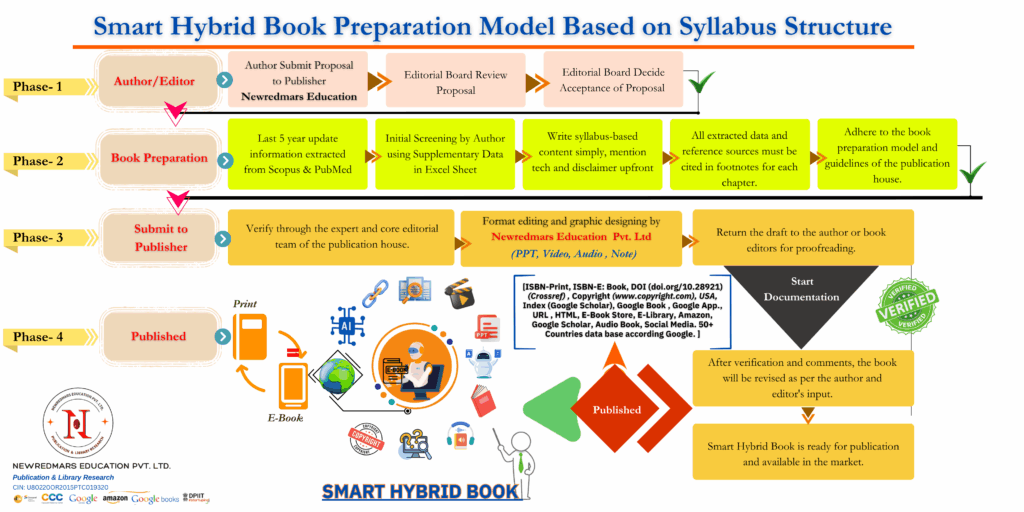
The content of the book shall be derived from peer reviewed and reputable academic databases, including but not limited to Scopus and PubMed.
Step 3: Specify formatting and academic standards
All submitted material must be properly structured, referenced, and formatted in accordance with accepted academic publishing standards.
Step 4: Define authorship and content development responsibility
The intellectual content of the book must be clearly developed and organized by the author. In the case of call for book projects, content development may be undertaken by the Core Review Committee and the Library Research Team of Newredmars Education.
Step 5: Limit use and intent
The publication is intended exclusively for academic activities, educational use, and research dissemination. Any commercial, promotional, or non academic use is strictly prohibited.
Front Matter Requirements
Step 6: Define the front document requirement
Each book must include a front document providing complete and accurate contributor information.
Step 7: Specify contributor details
The front document shall clearly state the full name and role of each contributor, including author, editor, and translator, along with their department, affiliated institution, and official address.
Step 8: Address retired faculty cases
In the case of retired professors, a corresponding address may be provided in place of an institutional affiliation.
Step 9: Define cover page requirements
The cover page of the book must be designed to accurately reflect the academic theme and subject matter of the content.
Step 10: Require contributor declaration
A signed declaration from the contributor must be included as a separate page, stating that the book is prepared solely for academic and research purposes.
Step 11: Clarify responsibility and verification
The declaration must confirm that the contributor has authored, reviewed, and verified all submitted documents and content, that all sources are accurately cited, and that the contributor accepts full responsibility for the authenticity, accuracy, and originality of the book.
Content Requirements
Step 12: Content structure
The manuscript must be clearly written, well organized, and presented in a chapter wise format, sequentially numbered.
Step 15: Table numbering standards
Tables must be numbered sequentially by chapter.
Step 16: Figure numbering standards
Figures must be numbered sequentially by chapter.
Step 17: Mandatory chapter components
- Summary
- Keynote
- Important Notes
Step 18: Page limit
The total length of the manuscript shall not exceed 300 pages.
Step 19: Bibliography requirements
A consolidated bibliography must be provided at the end of the book.
Step 20: Additional mandatory sections
- Index
- Glossary
- List of Figures
- List of Tables
- Appendix
Step 21: Supplementary documents
Supplementary materials must be labeled as Annexure 1, Annexure 2, and so on.
Book Design for Publication and Print Versions
Step 22: Book design and publication scope
The book shall be designed and formatted for both publication and print editions.
Step 23: Publication formats and trim sizes
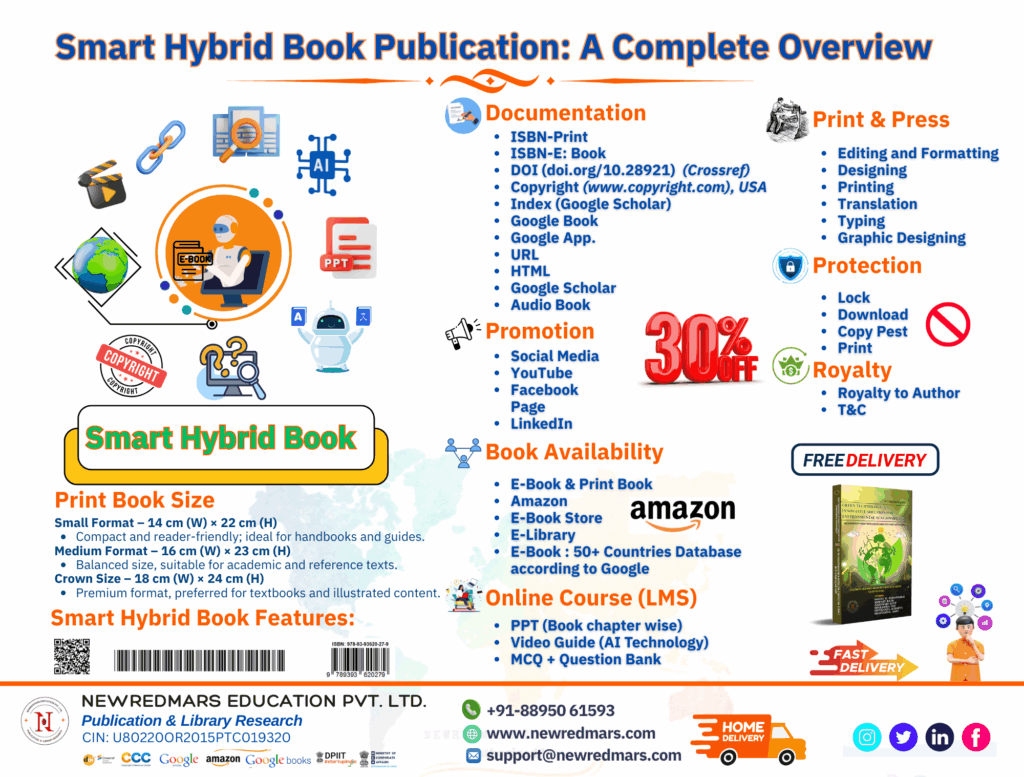
- Small: 14 cm × 22 cm
- Crown: 18 cm × 24 cm
- Royal: Custom size
Step 24: Post formatting publication letter
A formal letter of publication shall be issued after formatting approval.
Step 25: Typography and layout standards
- Font: Garamond
- Font size: 11 pt
- Line spacing: 1.15
- Margins: 1.5 inches on all sides
Step 26: Header and footer requirements
Odd pages shall display chapter titles. Even pages shall display the book title. Footers must show author name and page number.
Step 27: Availability formats
The book may be available in print, eBook, audiobook, and AI enabled video formats.
Step 28: Indexing and academic visibility
The publication may be indexed across national and international academic platforms.
Step 29: Promotional and marketing activities
Promotion may be conducted via YouTube, LinkedIn, and Facebook.
Step 31: Plagiarism compliance
The similarity index must not exceed 20 percent.
Step 33: Jurisdiction and dispute resolution
All legal matters shall fall under the jurisdiction of the Hon’ble High Court of Odisha.
Step 34: Royalty and financial terms
Royalty and financial transactions shall follow the official Terms and Conditions and be routed through the current account of Newredmars Education.